The Neutral Wording Myth in Policy Documents
The neutral wording myth in policy documents matters because labels shape which options seem reasonable; learn to spot framing and compare alternatives.
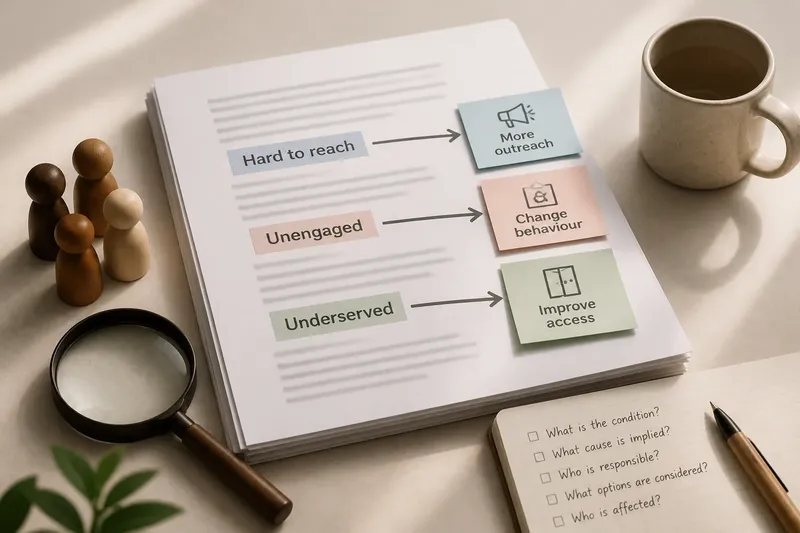
A policy document calls a group “hard to reach,” and a proposed response is to improve outreach. Another calls the same group “underserved,” making service capacity and access barriers harder to ignore. The neutral wording myth in policy documents is the idea that labels merely describe a problem. In practice, a label can quietly shape which remedies sound sensible before anyone compares them.
This does not mean every phrase is manipulative or that officials can write without choosing words. It means readers should ask what a label makes visible, what it leaves in the background, and whose circumstances it treats as the problem. The right reading strategy depends on your situation: you might be checking a consultation paper, assessing a proposed rule, or trying to understand how an audience has been defined.
Are you reading a document that names a problem?
Start by separating the observed condition from the interpretation attached to it. A document may report missed appointments, low use of a service, or repeated applications. Those are descriptions of activity. Calling them “noncompliance,” “disengagement,” or “administrative burden” adds a theory about why they happen and who should respond.
Look for the sentence that moves from a condition to a diagnosis. Ask whether the document identifies a cause, assumes one, or leaves it unstated. If residents are described as “unwilling to participate,” for example, the wording points toward changing residents’ behavior. If the text says participation is “limited by inaccessible meeting times,” the focus shifts to the arrangement of the process. Neither phrase settles the question by itself, but each directs attention toward different evidence and possible action.
For this situation, the useful decision is not whether the wording sounds polite. It is whether the diagnosis is supported and whether plausible alternatives are acknowledged. A careful document may describe the condition, name uncertainty, and explain why it favors one account over another. If it jumps from a label straight to a remedy, treat that jump as a point to examine.
Does the label describe people or the system around them?
When a document names its intended audience, check whether it locates difficulty in people, in institutions, or in the relationship between them. “Vulnerable households,” for instance, can draw attention to exposure to harm, but it can also make a broad group sound uniformly incapable. “Households facing barriers to access” points instead toward conditions that may vary and may be changed.
These descriptions are not interchangeable. A label can affect eligibility, the kind of evidence officials seek, and which groups are invited to comment. It may also obscure differences within a category. A policy aimed at “small businesses” could include a neighborhood shop and a regional supplier with very different needs. The category may be administratively convenient while still being too broad to explain who benefits or bears a cost.
Imagine a city document describing residents who miss waste-collection notices as “unengaged.” Say the city then proposes more reminders, while some residents receive notices only in a language they do not read. Reframing the audience as residents facing communication barriers would make translation and delivery channels reasonable options to consider. The expected observable result of that change in framing is a different set of questions in the document: which languages are served, how notices reach people, and whether the proposed response addresses those conditions.
Use this lens when a policy names a group as the source of a difficulty. Ask whether the text distinguishes individual circumstances from institutional design, and whether the category has clear boundaries. If it does not, the wording may be doing more work than its descriptive tone suggests.
Are you comparing proposed options?
When options are already on the page, trace how the problem label makes some choices look proportionate and others excessive. A document that frames an issue as “fraud” may foreground monitoring and penalties. A document that describes “unclear eligibility rules” may make simpler forms or better guidance seem more fitting. The label does not prove that one option is right; it can determine which options receive serious attention.
Read the reasons given for each option, not just the option names. Look for a consistent comparison: what condition does each response address, who is affected, and what trade-off does the document acknowledge? A remedy can appear neutral because it is described in technical language, yet still rest on an unstated assumption about responsibility.
For a quick comparison, make a small table with three columns: the label used, the cause implied, and the responses treated as plausible. Add a row for an alternative label that fits the same stated facts. This is like changing the label on a file folder: the papers inside may not change, but a reader may look for a different set of documents. The exercise does not decide policy; it reveals where the document’s reasoning depends on its wording.
This approach fits a reader reviewing a draft rule, options paper, or impact assessment. It is less useful to argue over a single word in isolation. Instead, ask whether replacing that word with a more precise description would alter the reasoning, the audience, or the options. If nothing changes, the term may be incidental. If the proposed response changes, the label is carrying policy weight.
Is the document using terms that sound factual?
Policy language often borrows the tone of measurement. Words such as “at risk,” “high need,” “hard to serve,” and “low capacity” may sound like settled categories, even when the document does not explain how they are defined. Find the point where the term is first used. Does the document specify what qualifies, whose judgment applies, and whether people can fall into more than one category?
When a term is defined, check whether the definition matches the decision being made. A category designed to describe need may not be suitable for allocating support. A label based on past service use may exclude people who could not access that service. Precision matters because a phrase can seem objective while concealing a choice about what counts.
If the term is undefined, do not assume that it has a single accepted meaning. Note the ambiguity and see whether later sections use it consistently. A reader commenting on the document can ask for a definition, an explanation of the evidence behind it, or a clearer account of who is included. That is more useful than simply calling the wording biased.
What should you check when the wording is contested?
What is the difference between a description and a frame?
A description states a condition that can be checked, such as a service being unavailable at a stated location or time. A frame interprets why the condition matters and what might explain it. Many policy sentences combine both, so separate the observable claim from the implied cause.
Can neutral-sounding language still shape a decision?
Yes. A term can direct attention toward certain causes and options without sounding emotional or partisan. Check what the document treats as the problem, what it treats as background, and whether another reasonable description would change the options under discussion.
How can I challenge a label without arguing over tone?
Point to the decision the label affects and ask for the basis of the category or diagnosis. Suggest a more specific alternative, then explain what evidence or options the revised wording would bring into view. This keeps the exchange focused on reasoning rather than presumed intent.
When should I accept a technical term?
Accept it provisionally when the document defines it, explains its relevance, and uses it consistently. If a technical term determines access, responsibility, or the range of remedies, ask how it was selected and whether it fits that decision.
Are you reading for public comment or personal understanding?
If you are trying to understand a policy, mark three things: the label for the problem, the group named as affected, and the response presented as reasonable. Then read the document again looking for evidence that connects those choices. This simple pass helps distinguish what the text states from what its framing suggests.
If you are preparing a public comment, be specific about the consequence of the wording. You might ask whether a group description excludes people with similar circumstances, whether a problem label assumes a cause that has not been established, or whether the alternatives section should consider a different response. A focused question gives the document’s authors something concrete to answer.
If you are drafting policy language, state the observable condition before assigning a cause. Define categories that affect decisions, explain why they matter, and test whether the same evidence supports more than one plausible interpretation. Where the evidence cannot distinguish among explanations, say so rather than presenting a chosen frame as a plain fact.
The neutral wording myth in policy documents is easiest to spot at the point where a label narrows the available choices. A reader does not need to prove that an author intended a particular effect. It is enough to show how the term guides attention, what it leaves out, and whether a more precise description would support a fairer comparison of options.
When a document leaves that reasoning visible, disagreement becomes easier to locate: readers can debate the evidence, the category, or the proposed response separately. That distinction is useful in public decisions because it turns a vague dispute about “bias” into a question officials and residents can actually examine.