Reading an Implementation Update Without Losing the Thread
Read an implementation update to identify what a public agency delivered, what remains unresolved, and which precise questions its wording leaves open.
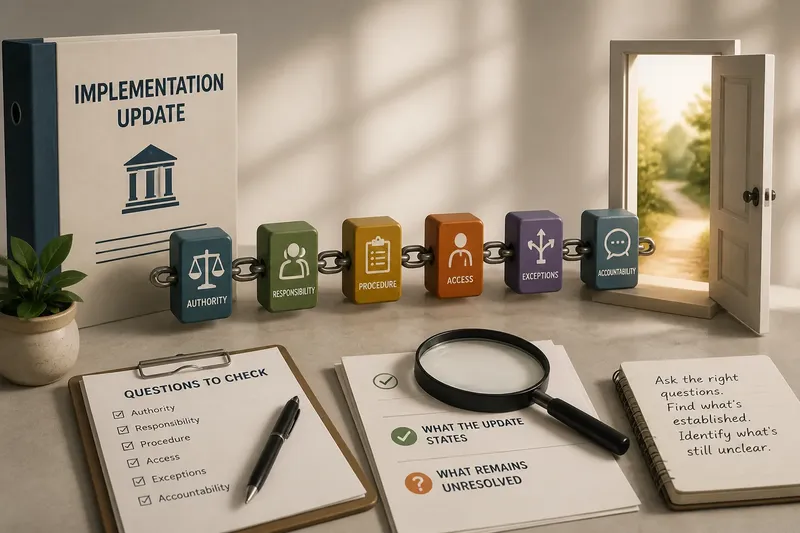
When an agency says a new application process is “available,” a resident still needs to know where to apply and whether the process is actually open to them. Reading an implementation update carefully helps you separate what the document states from what it leaves unanswered.
Instead of following a report’s timeline, examine the chain between a policy decision and a public-facing result: authority, operational arrangements, access, and accountability. A report may describe one link without establishing the next. That distinction helps you identify where a decision has been put into practice and where the public still needs clearer information.
What does an implementation update actually describe?
Implementation means the work of putting an adopted policy into operation. An update might cover rules, staffing, forms, contracts, public notices, or how an office handles requests. These are different parts of delivery, not interchangeable evidence that the intended service or benefit is available.
Read for the specific object of each claim. A statement that an agency issued a rule describes a rule; a statement that it hired staff describes staffing. Neither alone establishes that a resident can use a service or that a policy has produced its intended effect.
Think of a policy like a door with several locks: opening one does not show that the whole route is clear. The analogy is useful because implementation depends on connected arrangements, while an update may report only one of them.
How can you trace a policy from authority to access?
Follow the practical chain in the document. Ask what authorizes the action, which office is responsible, what procedure people must use, and what happens when that procedure does not work. Each answer points to a distinct design choice.
- Authority: Does the update name the law, regulation, executive decision, or adopted policy that permits the action? If it does, identify that source; if it does not, record the basis as unspecified and avoid assuming which rule applies.
- Responsibility: Does it identify the agency or office accountable for delivery? If it does, note the named unit; if it does not, ask which body owns the task rather than assigning responsibility by guesswork.
- Procedure: Does it explain what a person must do, such as submit a form or contact an office? If it does, note the stated route; if it does not, mark the public process unclear and look for a separate instruction document.
- Access: Does it say who can use the service and how to request help or an alternative format? If it does, note the stated conditions; if it does not, ask whether eligibility and access arrangements are documented elsewhere.
- Exceptions: Does it describe how staff handle an incomplete request, a denial, or a case outside the standard process? If it does, note the available route; if it does not, identify the missing procedure without assuming there is no recourse.
- Accountability: Does it name a contact, complaint route, or review process? If it does, note how a person can raise a concern; if it does not, ask the agency to identify the appropriate channel.
This is not a demand that every update contain every operational detail. It is a way to see whether the update answers the question a reader has, and which document or public explanation might fill the gap.
What can a worked reading reveal?
Say an invented city update states that the council adopted a home-repair grant policy, the housing office issued an application form, and staff are preparing instructions for residents. It does not name an opening date, explain eligibility, or describe how applicants can appeal a denial.
First, record the policy adoption as the authority the update identifies, while noting that the document does not specify any further legal basis. Next, record the form as a published administrative item, not as proof that applications are being accepted. Then mark the instructions as preparation work, since the update says they are not yet complete.
The resulting assessment is narrow: the city reports an adopted policy and a form, but the update does not establish that residents can apply, who qualifies, or what review is available after a denial. The useful follow-up is to ask the housing office whether applications are open, where the eligibility rules are published, and how a decision can be challenged. Those questions address the actual gaps without claiming the program has failed.
How do you tell an unclear explanation from a policy gap?
An update may omit a detail because it appears in another document, such as a regulation, service page, or staff manual. That is an information gap in the update; it does not by itself prove that the underlying policy lacks a procedure.
A policy gap is a stronger claim. It requires evidence that the relevant rule or process is absent, contradictory, or unable to address the issue—not simply that one report is brief. Check the cited regulations, agency instructions, and public-facing materials before deciding which description fits. If those sources are unavailable, say that the process is not clear from the documents you could review.
Which questions help clarify an implementation update?
Does a published form mean applications are open?
No. A form can be available before an agency begins accepting submissions. Look for an explicit statement about how and when to submit it, and ask the responsible office if the update does not say.
Who should answer a question about a service?
Start with the office the update names as responsible for delivery. If no office is named, contact the agency that issued the update and ask which unit handles the service.
What should I do if the update refers to another document?
Find the cited rule, instruction page, or application materials and check whether they answer the specific question. If the reference is incomplete or the materials cannot be located, record that limitation rather than filling in the missing detail.
Does an unclear process mean the policy is not being implemented?
Not necessarily. The update may be incomplete, or operational details may be published elsewhere. Describe what the available documents establish and what remains unconfirmed.
How should you describe what the documents establish?
Use language that matches the evidence. “The update says the agency issued a form” attributes a claim to the document; “residents can apply” asserts a public-facing fact that requires separate confirmation. This difference matters when an update describes internal work alongside a broader policy goal.
Keep three distinctions in your notes: what the policy authorizes, what the agency says it has put in place, and what the documents show about public access or recourse. If a source does not answer one of those questions, name the gap and identify the office or document that could clarify it.
A careful reading of an implementation update can help residents, reporters, and public officials ask more precise questions about how a decision reaches the people it concerns. When you use the phrase implementation update, make clear which part of that chain the document actually addresses; the distinction gives others a specific place to verify, clarify, or improve the public explanation.